
Independent Living supports active seniors who manage daily tasks independently in a community setting with social amenities. Assisted Living provides personal care assistance with Activities of Daily Living (ADL) like bathing and medication management. Skilled Nursing Care delivers 24-hour medical supervision by Registered Nurses (RN) and Licensed Practical Nurses (LPN) for seniors with chronic conditions or post-acute care needs. The primary difference lies in medical care intensity and independence levels, not just housing type.
Quick Comparison: Senior Living Options at a Glance
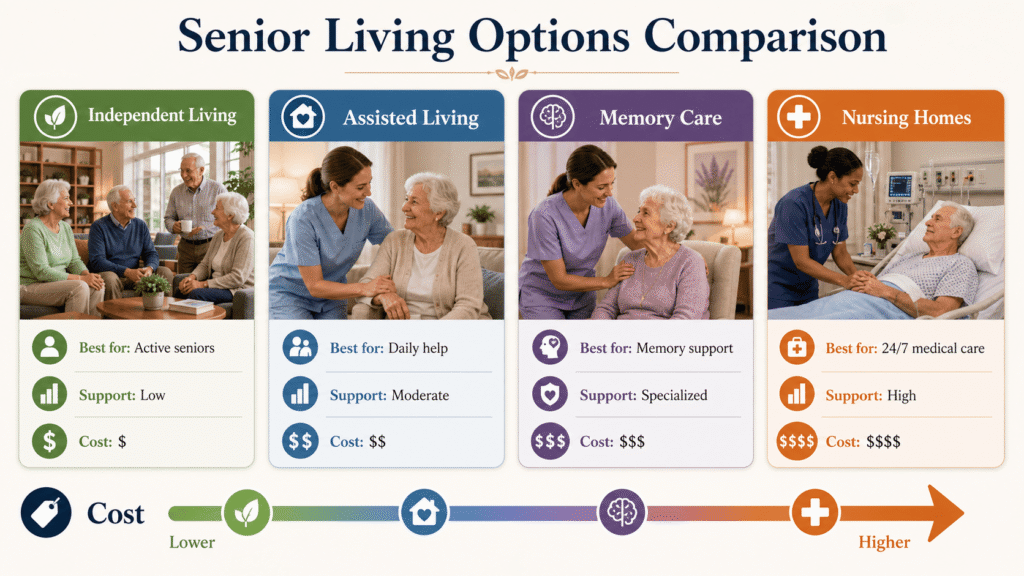
| Feature | Independent Living | Assisted Living | Skilled Nursing Care |
|---|---|---|---|
| Care Level | No medical care; social support only | Personal care with ADL assistance | 24-hour medical supervision |
| Medical Staffing | No medical staff on-site | Personal Care Aides, some LPNs | RNs, LPNs, CNAs, therapists |
| Average Monthly Cost | $1,500–$4,000 | $4,500–$6,500 | $7,500–$12,000 |
| Medicare Coverage | No | No (long-term) | Yes (short-term, 100 days max) |
| Medicaid Coverage | No | Limited in some states | Yes (custodial care) |
| Services Included | Dining Services, Housekeeping Services, Social Activities | Medication Management, Mobility Assistance, Personal Care | Rehabilitation Services, Chronic Condition Management, Medical Care |
| Ideal For | Active, independent seniors | Seniors needing daily assistance | Post-hospital, chronic illness, dementia patients |
What Is Independent Living and Who Needs It?

Independent Living communities cater to seniors aged 55+ who can perform all Activities of Daily Living without assistance. According to the National Investment Center for Seniors Housing & Care (NIC, 2024), these Retirement Communities focus on lifestyle enhancement rather than care provision. Residents live in apartments or cottages within a Senior Living Community and pay monthly fees covering housing, maintenance, and amenities.
Services Included in Independent Living Facilities
Independent senior living typically includes:
- Dining Services: One or two meals daily in community dining rooms
- Housekeeping Services: Weekly cleaning and linen services
- Transportation Services: Scheduled trips to appointments and shopping
- Social Activities: Fitness classes, hobby groups, educational programs
- Recreational Programs: Organized outings and entertainment
- Wellness Programs: Exercise facilities and health screenings
- Emergency Response System: Pull cords or wearable alert devices
Unlike Assisted Living or Nursing Homes, Independent Living does not provide medical care or personal assistance. Residents must arrange their own healthcare through external providers or Home Health Care agencies. This senior housing option suits individuals who want to downsize from larger homes while maintaining autonomy.
Who Qualifies for Independent Living?
Ideal candidates for independent living facilities can:
- Bathe, dress, and groom themselves without help
- Manage medications independently or with simple reminders
- Walk without significant mobility limitations
- Prepare simple meals if needed
- Handle financial and healthcare decisions
The average resident age is 75-80 years, though many communities accept younger retirees. Independent living for active seniors emphasizes social engagement over care services, making it distinct from medical-focused elderly care facilities.
What Is Assisted Living and How Does It Differ from Independent Living?
Assisted Living provides a middle ground between independence and full nursing care. According to the Assisted Living Federation of America (2024), approximately 810,000 Americans reside in Assisted Living Communities, receiving personalized support with daily tasks while maintaining some autonomy. This Residential Care Facility model targets seniors who need help with 1-3 Activities of Daily Living.
What Services Are Included in Assisted Living?
Assisted care services encompass:
- Medication Management: Staff administer or supervise medication intake
- Mobility Assistance: Help with walking, transfers, and fall prevention
- Personal Care Aides: Support with bathing, dressing, grooming, and toileting
- Dining Services: Three meals daily with dietary accommodations
- Housekeeping Services: Daily or weekly cleaning and laundry
- Transportation Services: Medical appointments and errands
- 24-hour Supervision: Staff available around-the-clock for emergencies
- Social Activities: Planned events and outings
Whereas Independent Living offers minimal intervention, Assisted Living creates individualized Care Plans based on resident assessments. Staff-to-resident ratios typically range from 1:8 to 1:15, depending on state regulations and facility size.
When to Move from Independent Living to Assisted Living
Signs you need assisted living instead of independent living include:
- Forgetting to take medications regularly
- Difficulty bathing or dressing safely
- Frequent falls or balance issues
- Weight loss from poor nutrition
- Neglecting personal hygiene
- Social withdrawal or depression
According to Genworth’s 2024 Cost of Care Survey, the national median cost for Assisted Living is $4,500 monthly, compared to $2,500 for Independent Living. This price difference reflects enhanced staffing and personalized care. Many Continuing Care Retirement Communities (CCRC) offer both levels within one campus, simplifying transitions when needs change.
Does Medicare Cover Assisted Living?
Medicare does not cover long-term care in Assisted Living facilities. However, Medicaid may cover costs in participating states through Home and Community-Based Services (HCBS) waivers. As of 2024, 47 states offer some Medicaid coverage for assisted living, though eligibility requires meeting income and asset limits (typically $2,000-$2,500 in countable assets).
What Is Skilled Nursing Care and When Is It Required?
Skilled Nursing Care represents the highest intensity level in the senior care continuum. Unlike Assisted Living, which provides custodial support, Skilled Nursing Facilities (SNF) deliver medical treatment by licensed healthcare professionals. The Centers for Medicare & Medicaid Services (CMS, 2024) defines skilled nursing as services requiring clinical judgment from Registered Nurses, therapists, or physicians.
What Services Are Included in Skilled Nursing Care?
Skilled nursing facilities provide:
- Medical Care: Wound care, IV therapy, ventilator management
- Rehabilitation Services: Physical Therapy, Occupational Therapy, Speech Therapy
- Chronic Condition Management: Diabetes, heart failure, COPD monitoring
- Medication Management: Complex pharmaceutical regimens
- 24-hour Supervision: RNs, LPNs, and Certified Nursing Assistants (CNA) on every shift
- Custodial Care: All ADL assistance
- Hospice Care: End-of-life support (when needed)
- Memory Care: Specialized dementia units in some facilities
Staffing requirements exceed those of Assisted Living significantly. Federal regulations mandate RNs on-duty 8 hours daily and LPNs/CNAs available 24/7. The RN-to-resident ratio averages 1:30, while CNA ratios range from 1:8 to 1:15.
When Does Someone Need Skilled Nursing Care?
Skilled nursing care after hospital discharge commonly occurs when patients require:
- Post-acute Care: Recovery from surgery, stroke, or fractures
- Subacute Care: Transitional care before returning home
- Short-term Care: Intensive rehabilitation (typically 20-100 days)
- Long-term Care: Permanent placement for advanced dementia or multiple chronic conditions
According to CMS data (2024), 32% of SNF admissions involve stroke recovery, 28% orthopedic rehabilitation, and 18% cardiac conditions. Do you need a doctor’s order for skilled nursing? Yes—Medicare and most insurers require physician certification of medical necessity every 30 days for coverage.
Transitioning from Assisted Living to Skilled Nursing
When to move from assisted living to skilled nursing depends on medical complexity rather than just ADL needs. Key triggers include:
- Need for RN assessment and treatment multiple times daily
- Complex wound care (stage 3-4 pressure ulcers)
- Tube feeding or IV nutrition
- Severe dementia requiring secured Memory Care units
- Behavioral health issues exceeding assisted living capabilities
Unlike the gradual decline prompting assisted living moves, skilled nursing transitions often occur suddenly following hospitalizations. Many families benefit from comparing senior care levels before crises arise to understand options.
How Do Costs and Payment Options Differ Across Senior Care Levels?
Understanding senior care comparison costs helps families budget appropriately. Genworth’s 2024 survey reports national median monthly costs:
- Independent Living: $2,500 ($1,500-$4,000 range)
- Assisted Living: $4,500 ($3,000-$6,500 range)
- Skilled Nursing Care: $9,733 for semi-private rooms ($7,500-$12,000 range)
How to Pay for Each Care Level
Independent Living payment sources:
- Personal savings and retirement accounts (100% self-pay)
- Long-term care insurance (rarely covers)
- Sale of primary residence
Assisted Living payment options:
- Private pay (67% of residents, ALFA 2024)
- Long-term care insurance (18%)
- Medicaid HCBS waivers (15% in participating states)
- Veterans Aid & Attendance benefits (up to $2,266/month for couples)
Skilled Nursing Care payment methods:
- Medicare: Covers 100% of days 1-20, partial days 21-100 for qualified stays
- Medicaid: Covers long-term custodial care after spend-down
- Long-term care insurance: Varies by policy
- Private pay: Average $9,733/month
Does Medicare cover skilled nursing care? Yes, but only for medically necessary short-term care following a 3-day inpatient hospital stay. Coverage requires daily skilled services and physician certification. After day 100, patients must transition to Medicaid, private pay, or home care.
Real-World Scenarios: Which Senior Living Option Fits Your Situation?
Scenario 1: Active 72-Year-Old Widower
Situation: Robert, 72, recently lost his wife and finds maintaining his 3-bedroom home overwhelming. He drives, manages medications independently, and enjoys golf and socializing.
Best Fit: Independent Living provides social engagement, maintenance-free living, and recreational programs without unnecessary care services. This retirement living arrangement allows autonomy while reducing isolation.
Scenario 2: 84-Year-Old with Mobility Issues
Situation: Margaret, 84, experienced two falls last year and struggles with bathing safely. She forgets evening medications but manages daytime doses. Her daughter lives 90 minutes away.
Best Fit: Assisted Living addresses mobility assistance needs and provides medication management support. The Emergency Response System and 24-hour supervision reduce fall risks while preserving dignity.
Scenario 3: Post-Stroke Rehabilitation
Situation: James, 79, suffered an ischemic stroke requiring intensive Physical Therapy, Occupational Therapy, and Speech Therapy. His hospital discharge planner recommends 6-8 weeks of rehabilitation.
Best Fit: Skilled Nursing Care provides daily therapy sessions and RN monitoring required for post-acute care. Medicare covers this short-term care for up to 100 days when medically necessary.
Scenario 4: Advanced Alzheimer’s Disease
Situation: Dorothy, 82, has stage 6 Alzheimer’s, requiring total ADL assistance, wandering prevention, and behavioral management. She previously lived in Assisted Living but her needs exceed their capabilities.
Best Fit: Skilled Nursing Care with specialized Memory Care units provides secure environments, higher staffing ratios, and dementia-trained CNAs. This long-term care setting addresses complex behavioral and medical needs.
Decision Framework: How to Choose the Right Senior Care Level
Use this assessment framework when comparing senior care levels:
Choose Independent Living If:
- You perform all ADLs independently
- You want social engagement and amenities
- You can manage medications without assistance
- You have no chronic conditions requiring daily monitoring
- You’re seeking retirement housing options focused on lifestyle
Choose Assisted Living If:
- You need help with 1-3 ADLs (bathing, dressing, medication)
- You experience occasional confusion but don’t require constant supervision
- You benefit from structured social activities and meals
- You want to age in place with increasing care levels available
- Your family seeks peace of mind with 24-hour supervision
Choose Skilled Nursing Care If:
- You require daily skilled nursing interventions (wound care, IV therapy)
- You need intensive rehabilitation services post-hospitalization
- You have multiple chronic conditions requiring RN monitoring
- You need total assistance with all ADLs
- You have advanced dementia requiring secured environments
- Medicare or Medicaid will cover your care costs
What Level of Care Does My Parent Need?
Consult healthcare providers for formal assessments evaluating:
- ADL performance (bathing, dressing, toileting, transferring, continence, feeding)
- Instrumental ADLs (medication management, finances, meal preparation)
- Cognitive function (memory, decision-making, safety awareness)
- Medical complexity (chronic conditions, treatment requirements)
- Social support and caregiver burnout levels
Many Continuing Care Retirement Communities (CCRC) offer all three care levels on one campus, enabling seamless transitions as needs evolve. This continuum model, also called senior care continuum planning, provides long-term stability and familiarity.
Understanding the differences between Independent Living, Assisted Living, and Skilled Nursing Care empowers families to make informed decisions matching current needs and future planning. Each senior living option serves distinct populations with varying independence levels, medical requirements, and cost structures. Regular reassessment ensures appropriate care levels as health status changes, maximizing quality of life while managing expenses effectively.